
Creating The Circular Carbon Economy
Menu
SCENARIO 05
Sponge Cities & Rainwater Management
Target biochar-containing substrates where urban water and greening benefits are measurable.
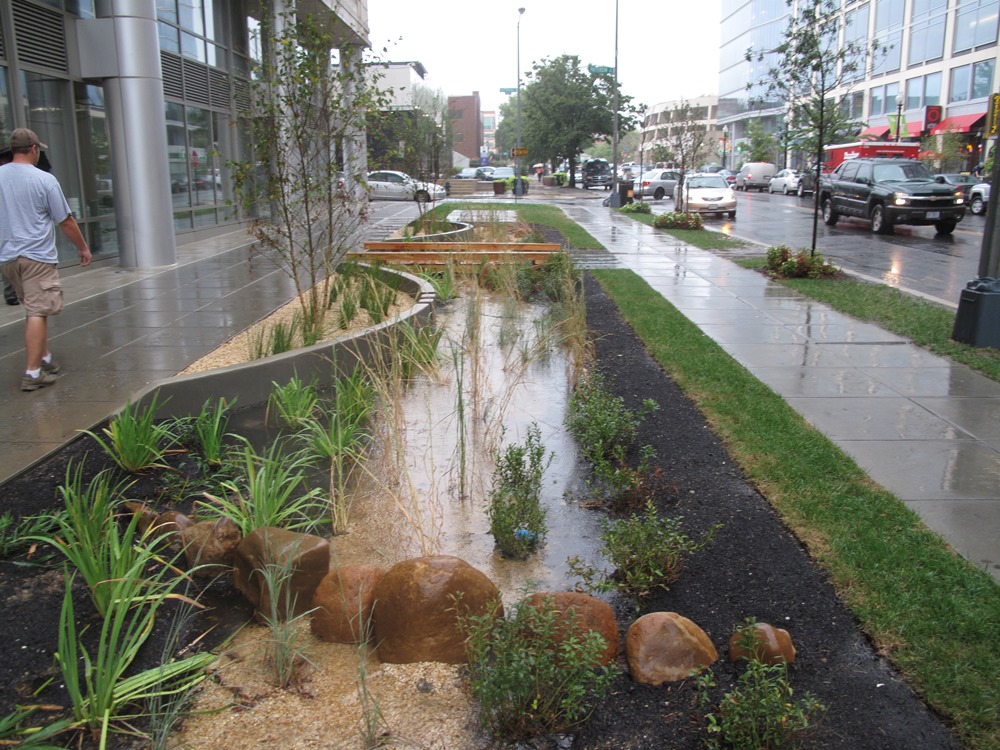
The Challenge
Heavy rainfall, drought, compacted urban soils and pressure on green infrastructure call for site-specific climate-adaptation measures. Biochar can be explored as an ingredient in engineered substrates, but its value depends on the intended water or vegetation service. Increased water retention is not beneficial in every location, especially where drainage is already poor.
How the solution works
Potential applications include rain gardens, green roofs and walls, urban tree pits, rehabilitated soils, stormwater systems and selected sports infrastructure. Biochar may alter substrate density, structure and water-holding behaviour and potentially reduce dependence on peat. It should be considered as one component of a designed system rather than a universal additive.
Where to start and at what scale
Begin with a single tree pit, rain garden, roof or test plot. A neighbourhood programme can follow if monitored results justify replication. Define a functional service such as rainfall retained under a specified event, plant survival or improvement in substrate performance. Compare a biochar-containing formulation with a suitable conventional solution under the same site conditions.
Material requirements and CASCADE experience
The Rennes Métropole activities combined urban demonstrations, stakeholder interviews, territorial analysis and conversion experiments. The resulting recommendation is to choose the right material for the right location. Substrate properties to assess include hydraulic conductivity, water retention, density, particle size, pH, salinity, plant compatibility and contaminant leaching. The full blend must be tested. The Rennes work does not provide a universally validated substrate recipe or an immediately scalable production model.
Recommended first steps
Identify one clearly measurable urban problem and survey site hydrology, soil, vegetation and maintenance conditions. Specify the target performance and choose a reference solution. Test biochar and the proposed substrate blend, including environmental suitability. Install a controlled demonstrator and document composition, dosage, baseline and installation method. Monitor through relevant seasons before extending procurement or production.
Related applications & calculators
See how biochar can be used in rain gardens and estimate the amount needed for your planting mix. If your project includes new urban trees, the planting calculator can also help you estimate how much biochar and compost you’ll need.
Connect with the CCMS
Use local application and biomass market analysis to link municipal demand with suitable supply. Causal-loop and stakeholder tools can connect drainage, parks, procurement and maintenance services. A Carbon Manager can help prepare a phased urban-resilience action plan. Evidence status: site-specific demonstrations and exploratory assessments; broader performance and climate benefits depend on additional measurement.