
Creating The Circular Carbon Economy
Menu
SCENARIO 01
Water Cleaning & Greywater Reuse
Cleaner water through carefully selected biogenic carbon materials.
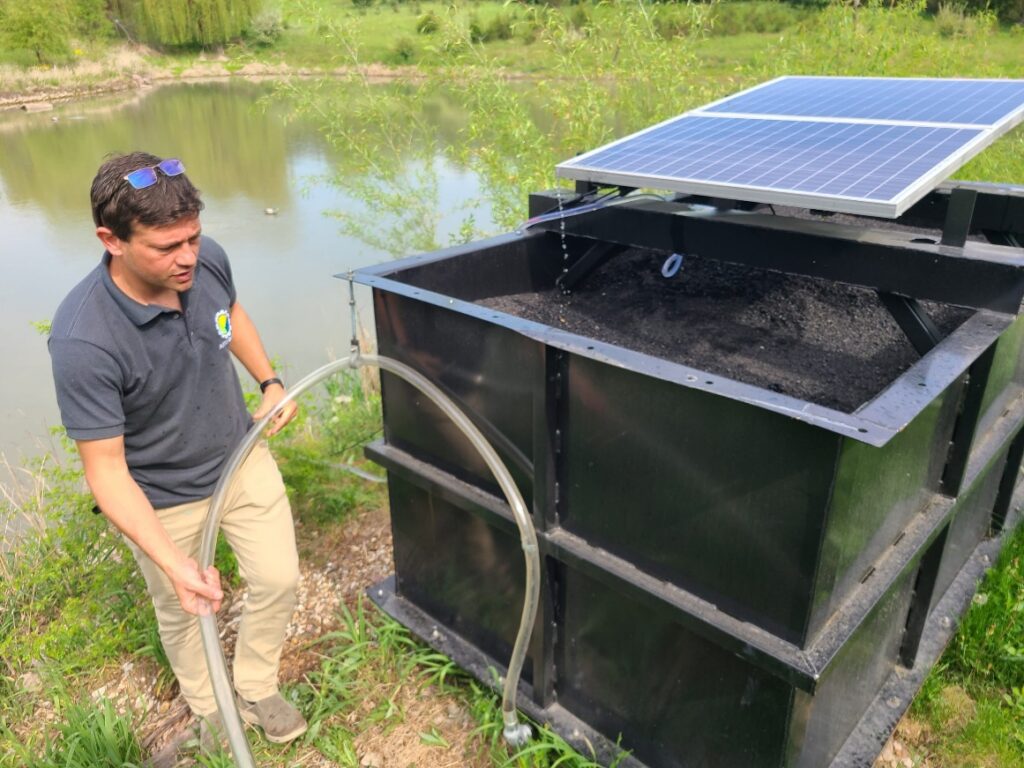
The Challenge
Municipal wastewater can contain residual pharmaceuticals and other organic micropollutants after conventional treatment. Separately collected household greywater can also require additional treatment before suitable reuse. Both situations raise a practical question: can carbon materials made from regional biomass deliver a useful treatment service without compromising water safety or operational reliability?
How the solution works
CASCADE examines two distinct applications. In municipal wastewater treatment, biogenic powdered activated carbon (BPAC) could potentially substitute conventional powdered activated carbon in a polishing stage. In buildings, a granular biogenic carbon filter could be investigated as an optional polishing stage after an existing greywater treatment system. Neither is a stand-alone replacement for established treatment and hygiene barriers.
Where to start and at what scale
A municipal wastewater treatment plant provides the relevant setting for the first application; a single household, building or small neighbourhood is the starting scale for the second. Define the target water quality and compare the proposed treatment with the existing reference system. For a municipal plant, use removal of specified micropollutants per cubic metre treated as a functional measure. For greywater, assess the quality and quantity of water safely made available for its intended reuse.
Material requirements and CASCADE experience
Adsorption performance depends on feedstock, carbonisation, activation, pore structure and the substances to be removed. CASCADE reviewed laboratory evidence for selected biogenic activated carbons and identified potential screening indicators, including pore-volume measures and methylene blue number. Such indicators do not replace trials with the actual wastewater. The household carbon-polishing concept has not been tested in the selected reference installation. Existing studies suggest potential benefits, but they also demonstrate that organic-matter removal does not guarantee microbiological safety.
Recommended first steps
Specify the water-treatment problem and measurable removal targets. Select a suitable, traceable carbon material and a commercial comparator. Undertake controlled laboratory or sidestream trials with representative water. Evaluate dose, contact time, flow, breakthrough, hygiene, spent-carbon management and costs. Proceed to a bounded pilot only if the additional treatment benefit is demonstrated.
Related applications & calculators
Explore how biochar can capture pollutants in surface runoff and estimate how much filter material a sediment trap might need. This example covers surface water filtration. Wastewater treatment and greywater reuse have their own treatment and water quality requirements.
Connect with the CCMS
Use the market-analysis service to identify biomass and water-treatment demand; involve treatment operators, laboratories and regulators in stakeholder mapping. A Carbon Manager can coordinate a feasibility study and develop an action plan. Evidence status: promising application-specific research and exploratory CASCADE configurations; not a validated ready-to-install solution.