
Creating The Circular Carbon Economy
BIOCHAR APPLICATIONS / WATER MANAGEMENT
Filter runoff. Protect waterways.
Biochar as a filter for rainwater and surface runoff
Use biochar in catchment chambers to intercept pollutants in urban and agricultural runoff.
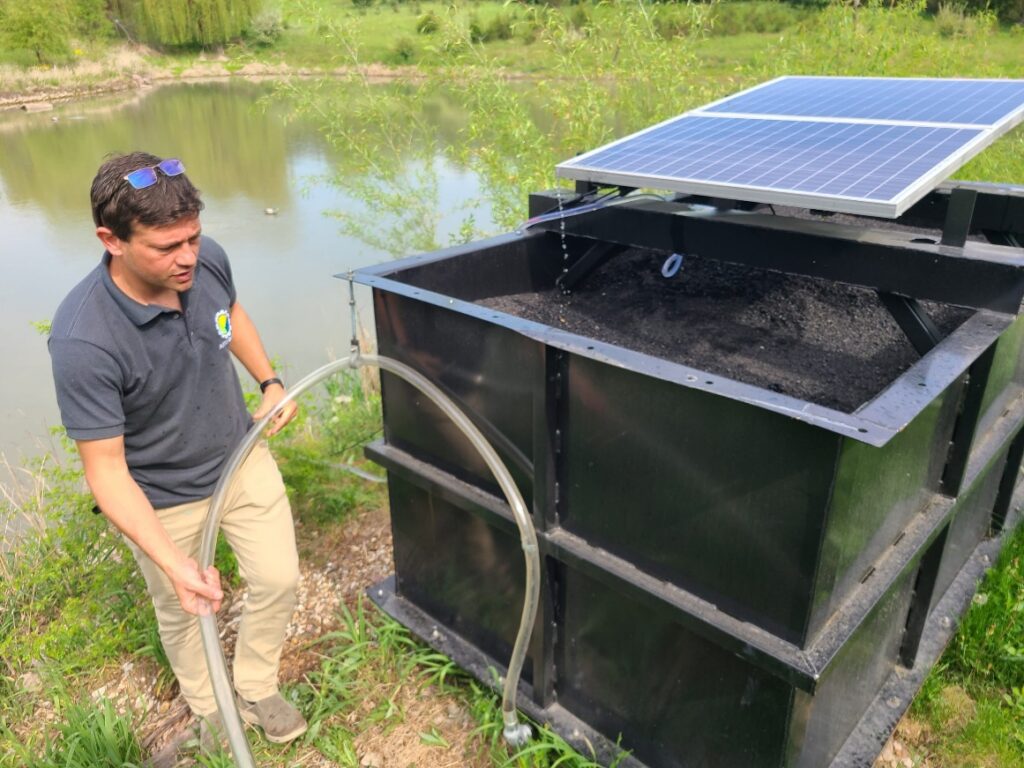
THE APPLICATION AT A GLANCE
Catch pollutants before they spread.
The main purpose is to capture particles and chemicals before runoff reaches waterways. Biochar can be made in quantity from local waste materials at relatively low cost.
Match pore structure to the pollutant. The size and number of internal pores can be tailored to capture specific contaminants in stormwater and surface runoff.
Recover nutrients from farm runoff. When the filter captures nutrients from organic runoff, suitable spent biochar can be co-composted and applied to land. The recovered nutrients may reduce the need for synthetic fertiliser.
Manage potentially toxic contaminants separately. For industrial or highway runoff, assess spent biochar before considering re-pyrolysis or incorporation into concrete or asphalt. In suitable cases, re-pyrolysis may allow up to 90% of the filter material to be reused. Reuse depends on what the filter has captured and the properties of the treated material.
Replace media as needed. How often the filter needs changing depends on the type and concentration of contaminants in the water.
01 / POLLUTION
Intercept Pollutants
Capture particles and chemicals before runoff reaches receiving waters.
02 / WATER QUALITY
Protect Aquatic Habitats
Reduce pollutant loads that can affect water quality and aquatic ecosystems.
03 / REUSE
Recover Useful Material
Assess nutrient recovery or filter media reuse based on what the biochar has captured.
EXPLORE YOUR OWN SCENARIO
How much media might you need?
Use water flow and the number of sediment traps to estimate biochar quantity and material cost.
ASPHALT CALCULATOR
What to do
Please select the Biochar Type you want to use.
Enter the estimated maximum liquid flow rate.
Enter the number of sediment trap chambers.
Then click on the ‘Calculate’ button.
BEFORE YOU APPLY
Plan for the runoff and the spent filter.
Assess peak flow, target pollutants and how the filter medium will be handled when saturated.
Choose media and chamber capacity for the conditions the filter will face. Monitor performance to determine when the media should be replaced.
Test spent media before co-composting it, returning it to land or using it in construction. Re-pyrolysis can break down some organic pollutants. Check remaining contaminants, including metals, separately.
Where nutrient recovery can replace some synthetic fertiliser, consider the emissions associated with producing it. Fertiliser production emissions
LOOKING AT THE WHOLE PICTURE
Have biomass of your own?
The production calculator explores how much biochar you could make from your available resources.