
Creating The Circular Carbon Economy
BIOCHAR APPLICATIONS / CONSTRUCTION
Wall finishesthat breathe.
Biochar in internal plasters and external renders
Explore how biochar can complement lime and clay finishes, particularly when retrofitting older buildings.
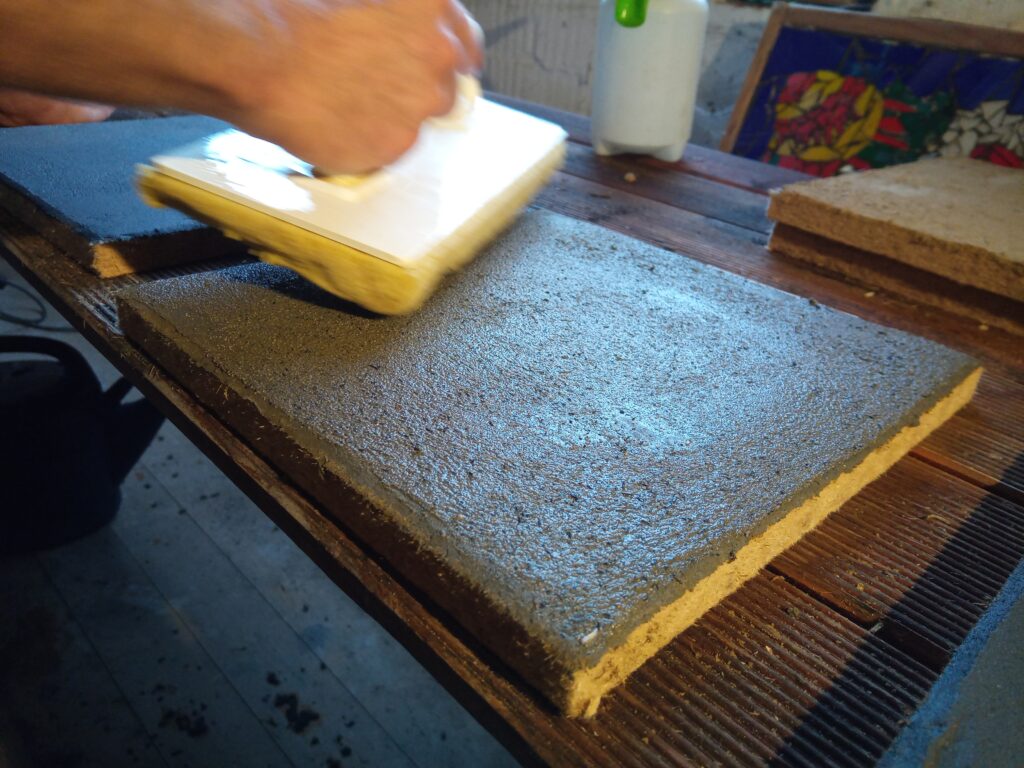
THE APPLICATION AT A GLANCE
Let walls release moisture.
Moisture control matters when upgrading solid brick and stone walls.
Moisture in older walls. Insulation can lower energy use and emissions, but unsuitable retrofits can trap moisture in solid brick or stone, contributing to decay and unhealthy indoor conditions. Replacing lime plaster with waterproof cement render can have a similar effect in historic buildings.
Lime and clay finishes. These materials can absorb and gradually release moisture. Adding biochar at shares of up to 50% has been explored to improve moisture buffering. Indoor relative humidity of 40–70% is an indicative range for this approach. Actual humidity depends on the mix, wall and ventilation.
Insulation and heating. Biochar can contribute to thermal insulation. A finish that improves moisture control and insulation may reduce heating demand and costs, depending on the building. Biochar can also attenuate electromagnetic waves, with performance depending on the material and formulation.
01 / MOISTURE
Let moisture escape
Choose a finish that allows the wall to dry.
02 / humidity
Buffer indoor humidity
Lime and clay finishes can absorb and release moisture as conditions change.
03 / Energy
Improve insulation
Assess the potential to reduce heat loss and heating demand.
EXPLORE YOUR OWN SCENARIO
How much biochar for your walls?
Enter the wall area. Use the example assumptions or adjust layer thickness, biochar share, density and price in Advanced.
PLASTERS & RENDERS CALCULATOR
What to do
Please select the Biochar Type you want to use.
Enter the number of square metres you want to apply Biochar to.
Then click on the ‘Calculate’ button.
BEFORE YOU APPLY
Choose a finish that suits the wall.
Consider how the wall takes up and releases moisture when choosing the mix and layer thickness.
Identify the masonry, existing coatings and sources of damp. For older solid walls, assess how the proposed layers affect drying.
Use a test area to check workability, adhesion and finish quality. Select a biochar share that suits the product and wall assembly.
Review the material and emissions data when comparing clay plaster with alternatives such as gypsum. Clayworks Sustainability Data (PDF)
LOOKING AT THE WHOLE PICTURE
Have biomass of your own?
The production calculator explores how much biochar you could make from your available resources.