
Creating The Circular Carbon Economy
Menu
SCENARIO 08
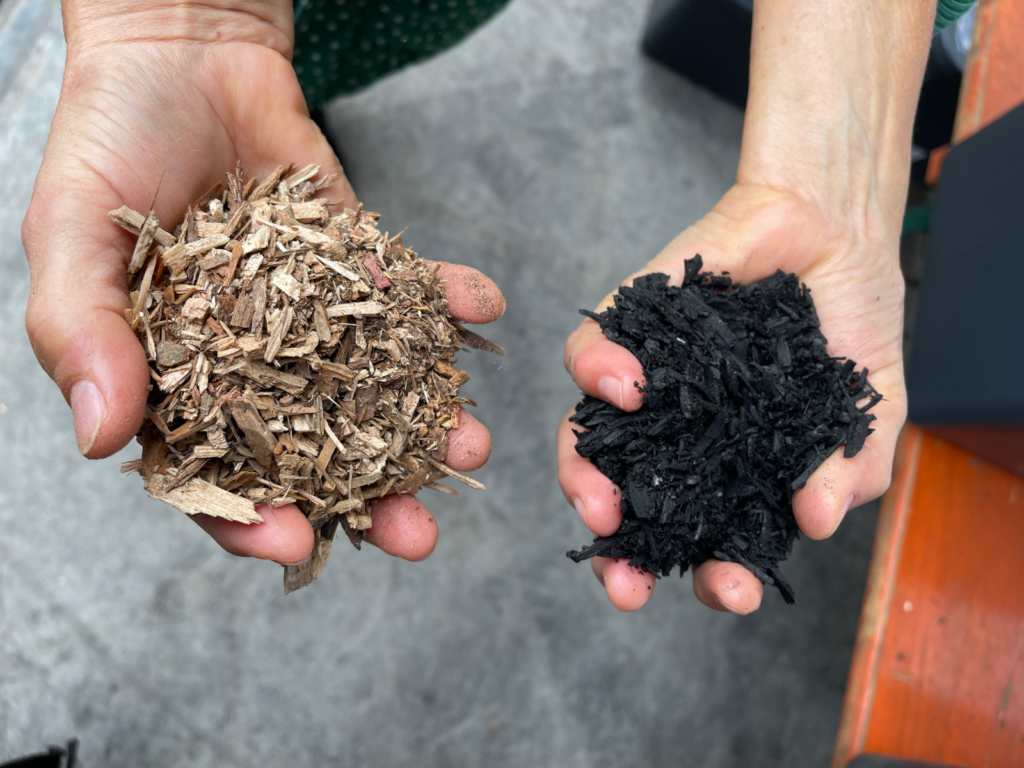
From Biomass to Biochar
Build your local production chain: harvest, pre-treatment, conversion and application-ready biochar.
The Challenge
Agricultural residues, conservation grassland cuttings, tree prunings and municipal green residues can support new circular carbon value chains. Yet an available biomass resource does not automatically make a viable biochar product. Moisture, minerals, contamination, seasonal supply, collection costs and competing uses can constrain processing. The challenge is to design a local chain that matches sustainable feedstock recovery, safe conversion, useful heat recovery where feasible, and a realistic end use for the resulting biochar.
How the solution works
CASCADE links five process stages. Harvest and recovery: identify sustainable biomass sources, ownership, existing uses, seasonal availability and collection logistics. Pre-treatment: sort, shred, dry, press or pelletise biomass as necessary; IFBB-type separation may help with challenging herbaceous feedstocks. Conversion: select an appropriate controlled pyrolysis or carbonisation route and consider recoverable heat or electricity. Post-treatment: sieve, mill, granulate, nutrient-charge, activate or formulate the char only where its intended application requires it. Quality assessment: verify feedstock traceability, material safety and fit-for-purpose performance. Design the stages together rather than selecting a machine first.
Where to start and at what scale
Small scale (garden, farm or community): start with a clearly identified, manageable biomass stream and a safe, permitted conversion or demonstration approach. Medium scale (enterprise, cooperative or local hub): coordinate several suppliers, organised pre-treatment, qualified operation and potential heat users. Large scale (municipal or industrial): require long-term feedstock contracts, robust process control, emissions management and reliable product markets. Indicative planning bands are up to about 100 tonnes, 100–1,000 tonnes and more than 1,000 tonnes of biomass annually, respectively; actual boundaries depend on moisture, operating hours and technology. Use consistent fresh-mass and dry-matter assumptions.
Material requirements and CASCADE experience
Clean woody residues often offer a practical starting point after sorting, sizing and drying. Herbaceous material may need moisture and mineral management; CASCADE has explored IFBB pre-treatment for conservation grassland biomass. Mixed municipal residues require careful source separation and contaminant screening. CASCADE process work compares field-based, modular and infrastructure-embedded conversion systems and describes post-treatment options including grinding, densification, activation and formulation. Biochar quality is application-specific: horticulture calls for safe and compatible growing media; construction requires defined particle sizes and product performance; wastewater treatment may require activated carbon with demonstrated adsorption behaviour. No feedstock or conversion method guarantees suitability for every use.
Recommended first steps
- Map the local biomass: source, quantity, moisture, seasonality, current use and recovery constraints.
- Use THREE C Biomass Decision Help to identify initial suitability and processing questions.
- Use the Biochar Production Calculation Tool to estimate indicative yields, carbon content and recoverable energy, documenting assumptions.
- Compare small, medium and industrial configurations against available infrastructure, heat demand and operational capacity.
- Choose one or more application scenarios (1–7), establish the required biochar properties and decide what basic tests, partners and demonstrations are needed. Begin with a proportionate local trial and professionalise as the system grows.
Related tools & calculators
Start with the Biomass Decision Helper to explore processing options for your feedstock. Then use the Production Calculator to estimate biochar output, carbon content and recoverable energy. Browse the application pages to see what the biochar would need to do in its intended use.
Connect with the CCMS
Explore local opportunities: start with https://threec.eu/biomass-decision-help/ and https://threec.eu/biochar-production-calculation-tool/, then compare possible uses at https://threec.eu/biochar-applications-and-projects/. Get support: engage biomass suppliers, technology operators, product users and the CASCADE community; a Carbon Manager can support the feasibility pathway. Build your Action Plan: define system boundaries, responsible actors, biomass supply, processing route, expected outputs, quality checks and first milestones. The CCMS then supports implementation and continuous improvement through Plan–Do–Check–Act. Detailed certification and verified carbon accounting can be introduced when required for regulated or commercial uses.