
Creating The Circular Carbon Economy
Menu
SCENARIO 02
Urban Heat & Biochar Production
A modular regional hub linking landscape biomass, useful heat and biochar.
The Challenge
Small and seasonal quantities of conservation grassland biomass rarely justify a large urban pyrolysis plant. Yet landscape management generates material that may support renewable heat and carbon-product value chains if collection, pre-treatment, conversion and demand are coordinated. The central challenge is to establish a viable local system rather than maximise equipment size.
How the solution works
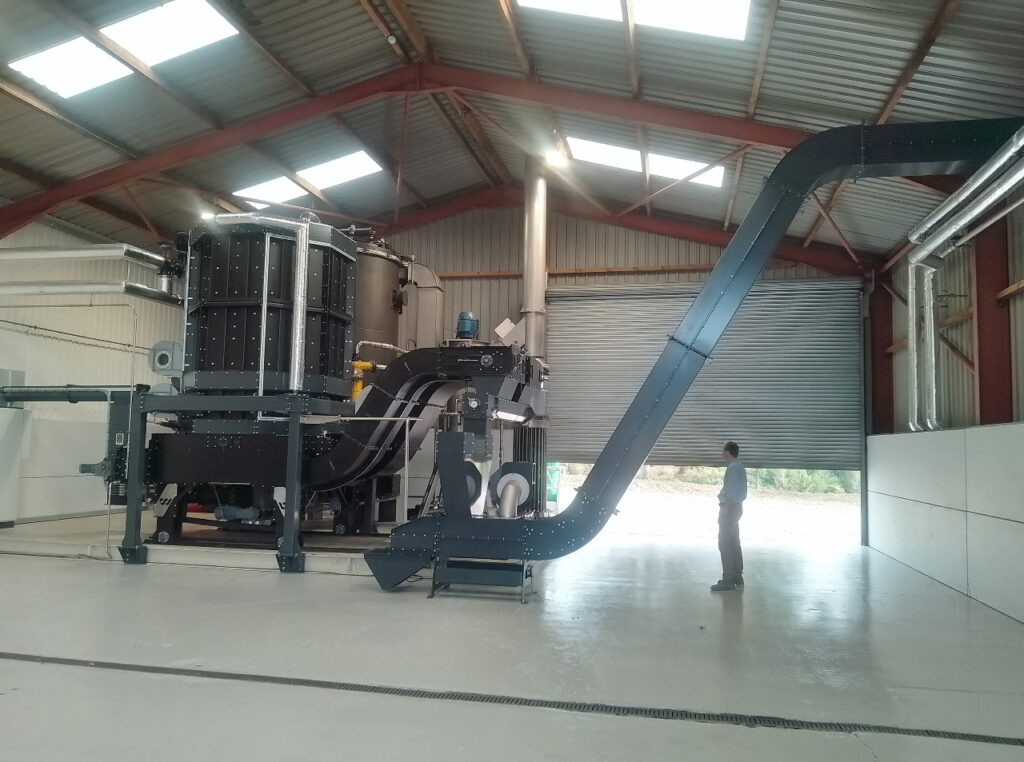
The working CASCADE concept combines biodiversity-oriented mowing with integrated generation of several outputs: grassland biomass is fractionated through IFBB, the press juice can feed a biogas route, and dried, pelletised press cake can be assessed as feedstock for a modular pyrolysis or pyrolytic heating unit. Useful process heat should first support drying and pre-treatment, with surplus heat supplied to a nearby user. Biochar is a separate product requiring quality assessment and a confirmed market.
Where to start and at what scale
The proposed boundary runs from recovery of conservation grassland biomass to delivery of useful heat and a quality-controlled carbon product. Candidate locations include municipal depots, biogas facilities, wastewater sites, cooperative biomass yards, greenhouses or small local heat networks. A peri-urban or municipal hub is more credible than a large centralised plant when feedstock is dispersed. A reliable nearby heat demand is a major decision condition.
Material requirements and CASCADE experience
The source concept cites an illustrative balance based on approximately 400 tonnes of fresh biomass per year, yielding around 80 tonnes dry biomass, 66.5 tonnes dry press cake and 12 tonnes biochar, alongside a press-juice methane pathway. These are scenario assumptions, not verified operating outputs. IFBB press-cake pellets may have an energy content comparable in order of magnitude to wood pellets, but ash, potassium, chlorine, nitrogen and ash-melting behaviour can create substantial operational constraints. They must not be treated as ordinary wood-pellet substitutes.
Recommended first steps
Map seasonal biomass supply and transport distances. Identify an anchor site with useful heat demand and access to appropriate infrastructure. Test representative pellets in candidate equipment for feeding, slagging, deposits, corrosion, emissions, stable operation, heat recovery and char yield. Characterise the biochar for a specific intended use. Compare the integrated pathway with existing biomass management and heat supply before committing to investment.
Related applications & calculators
See how pyrolysis projects use recovered heat and produce biochar. Enter your annual heat demand to estimate how much woodchip a project might need and how much biochar it could produce.
Connect with the CCMS
Link biomass supply analysis, heat-market mapping, technology and stakeholder assessment, carbon balances and an investment-oriented action plan. This scenario connects especially with biodiversity management (Scenario 3) and downstream biochar applications (Scenarios 4–6). Evidence status: conceptual regional system supported by CASCADE process investigations; detailed design and long-duration operational validation remain pending.